Celestial Mechanics Simulations
Overview
These projects, carried out under the mentorship of Professor Seppo Mikkola, introduced us to advanced celestial mechanics simulations. By studying and experimenting with his codes, we built a strong foundation in N-body dynamics and the numerical techniques used in astrophysical research.
Lyapunov Exponent Analysis
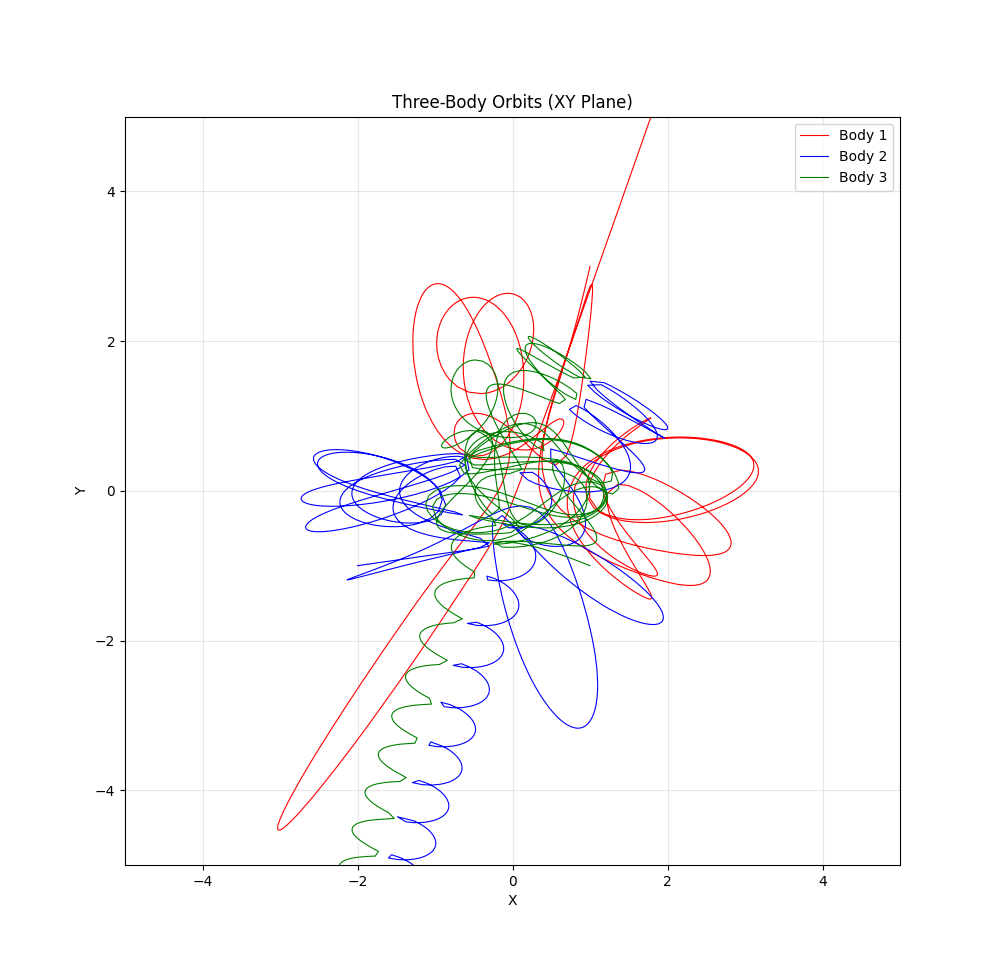
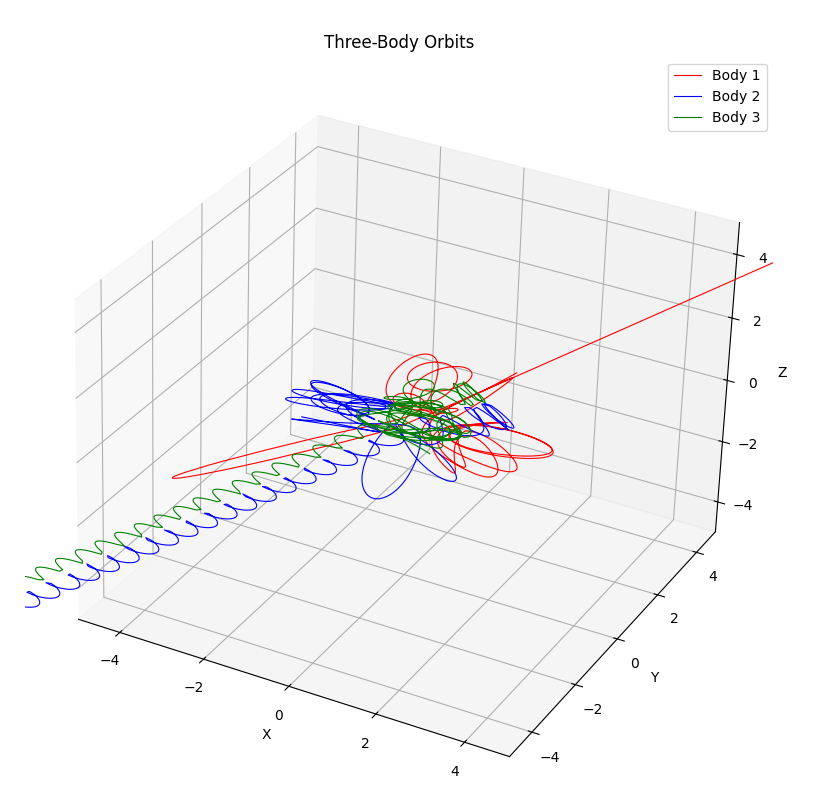
Investigated the stability and chaotic behavior of dynamical systems using Lyapunov exponents. Implemented algorithms to compute and visualize results in Python, gaining hands-on experience in analyzing system stability and chaos theory. The project involves compiling Fortran code and processing the 'Pythagorean' three-body problem to generate orbital trajectories.
Algorithmic Regularization Chain (ARC)
Implemented the Algorithmic Regularization Chain method for N-body simulations, which uses numerical time transformations to handle close encounters and singularities. The ARC method employs a TTL (Time Transformation Logic) function that automatically slows down integration near collisions, combined with Bulirsch-Stoer extrapolation for high accuracy. Achieved ~10⁻¹³ energy conservation in simulations of black hole binaries with post-Newtonian corrections and spin effects.
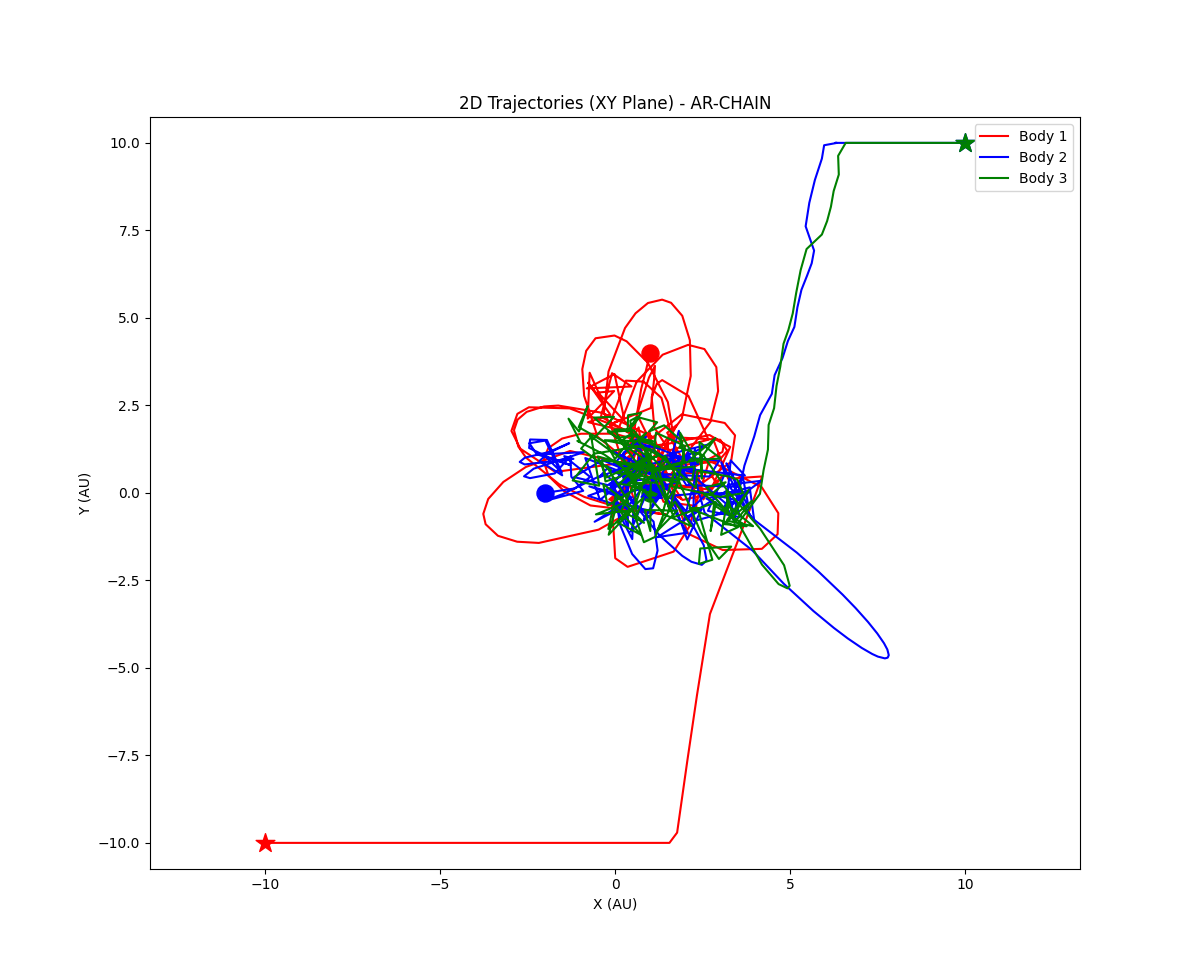
2D Plot
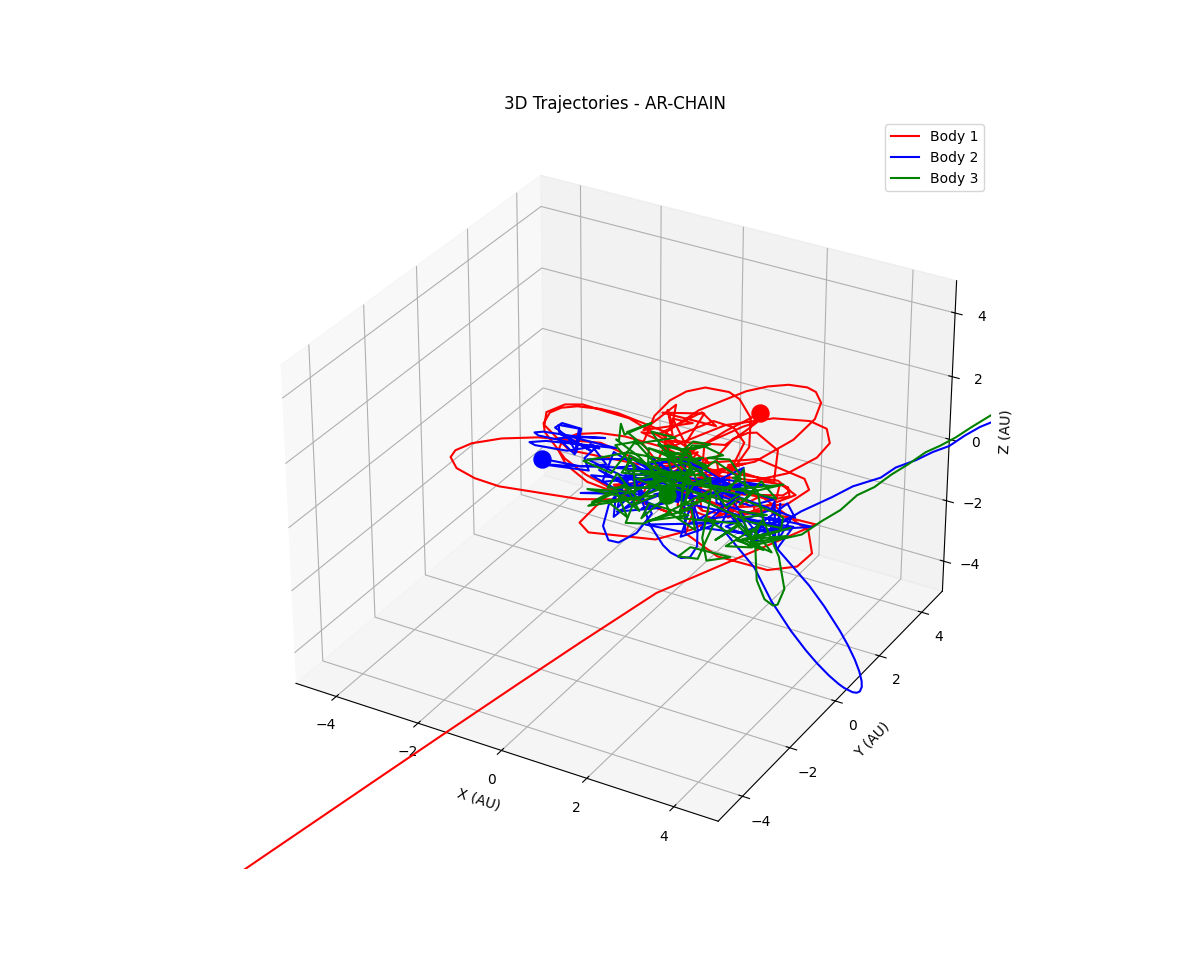
3D Plot
Kustaanheimo-Stiefel Chain (KSC)
Explored the Kustaanheimo-Stiefel regularization technique, a geometric method that lifts 3D space to 4D to eliminate singularities in the two-body problem. The KS transformation converts the singular Kepler problem into a smooth harmonic oscillator in 4D space. Extended to N-body systems using chain coordinates, this method excels at handling extremely close encounters (r ~ 10⁻⁸) and tight binary systems with remarkable stability and energy conservation.
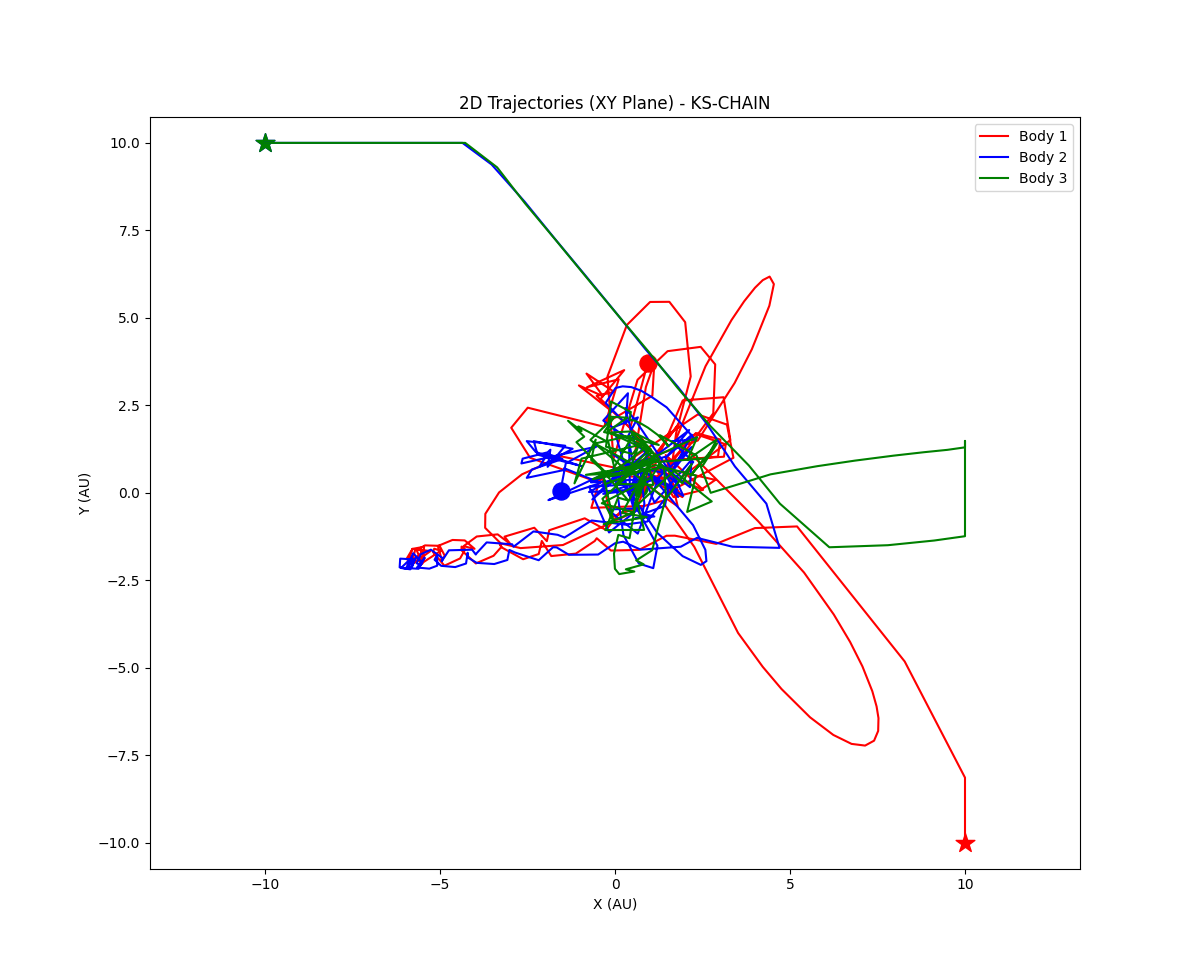
2D Plot
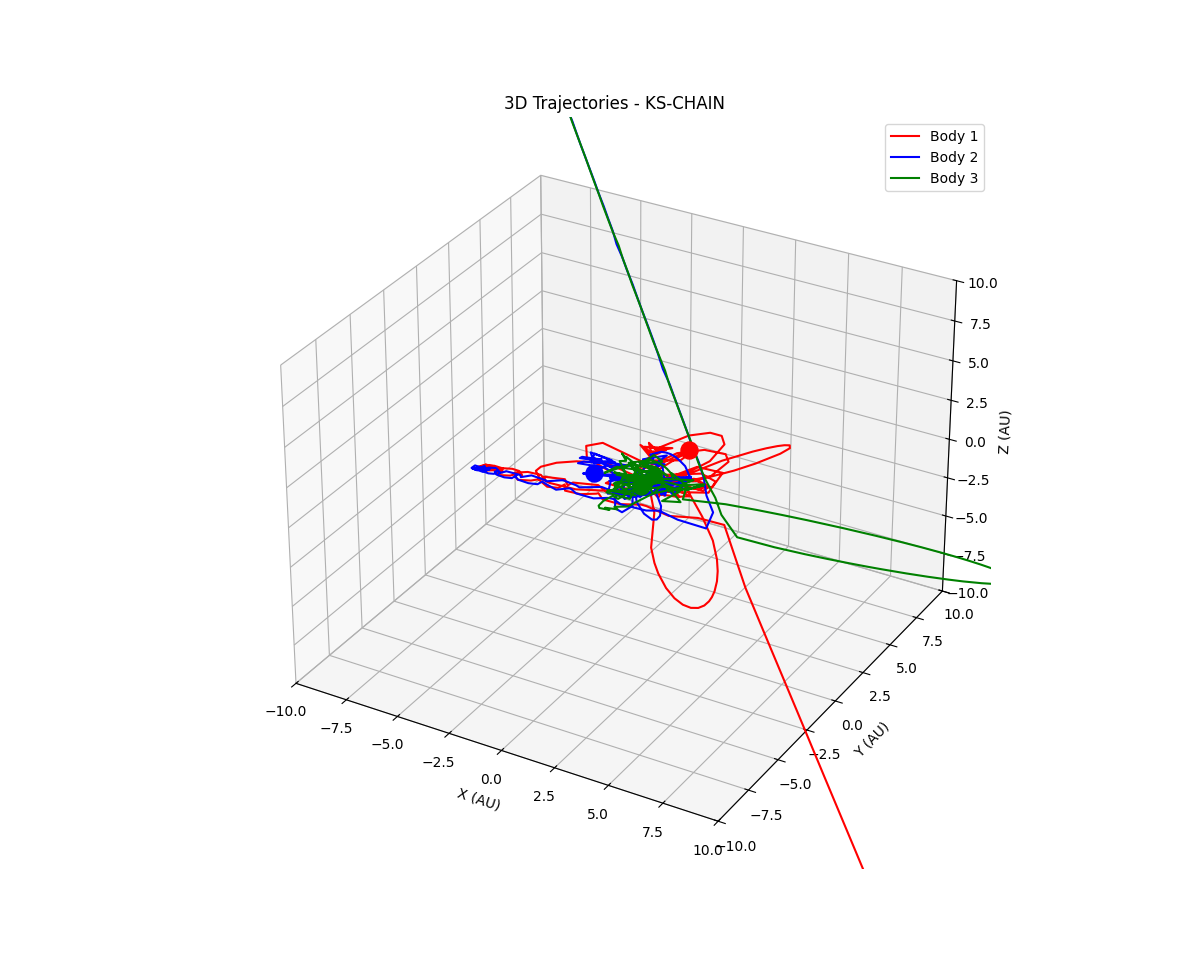
3D Plot
Modified Wisdom-Holman (MWH)
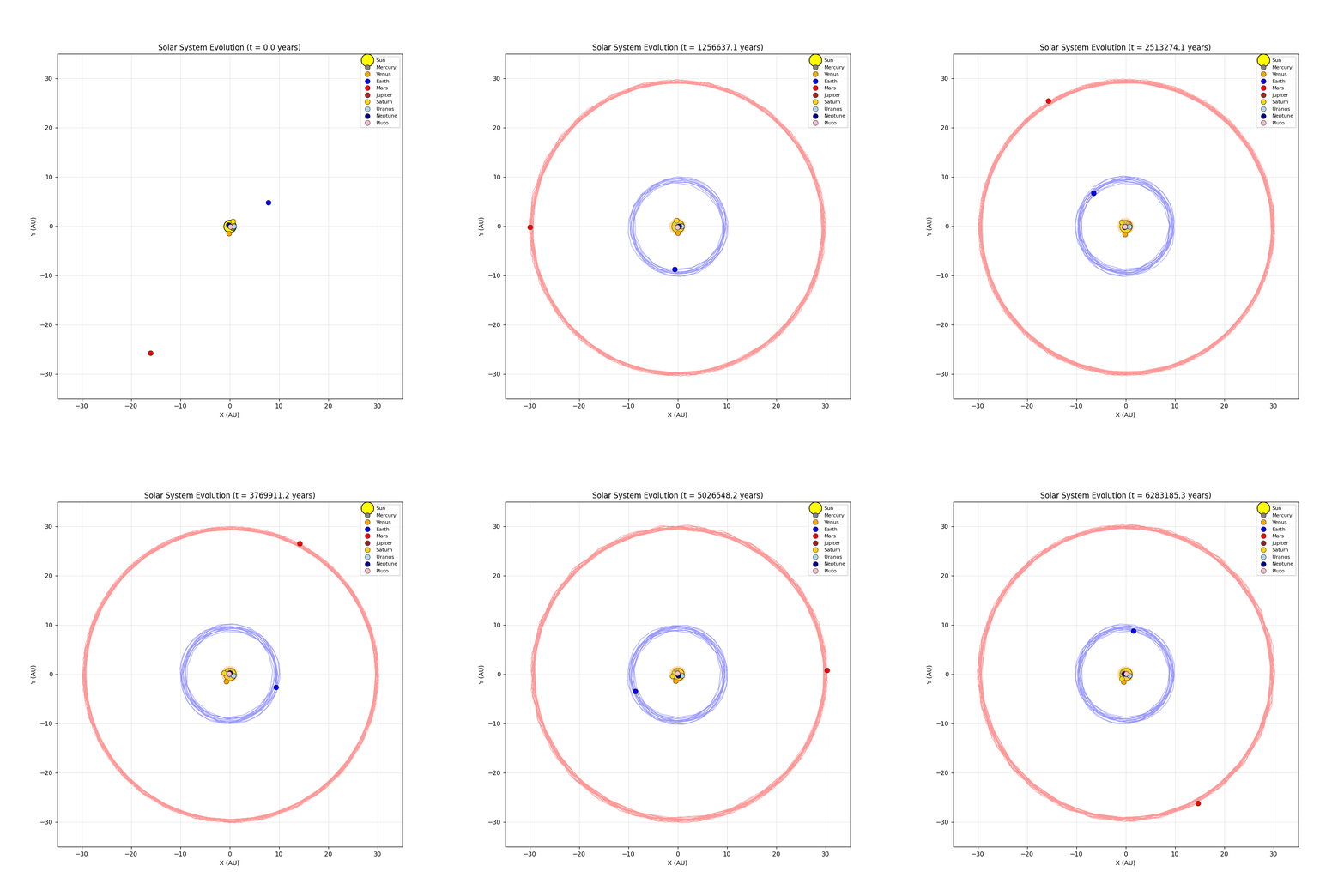
Implemented and ran high-precision gravitational N-body simulations using Seppo Mikkola's Modified Wisdom-Holman (MWH) integrator capable of simulating Solar System dynamics for 10 billion years with minimal energy drift.
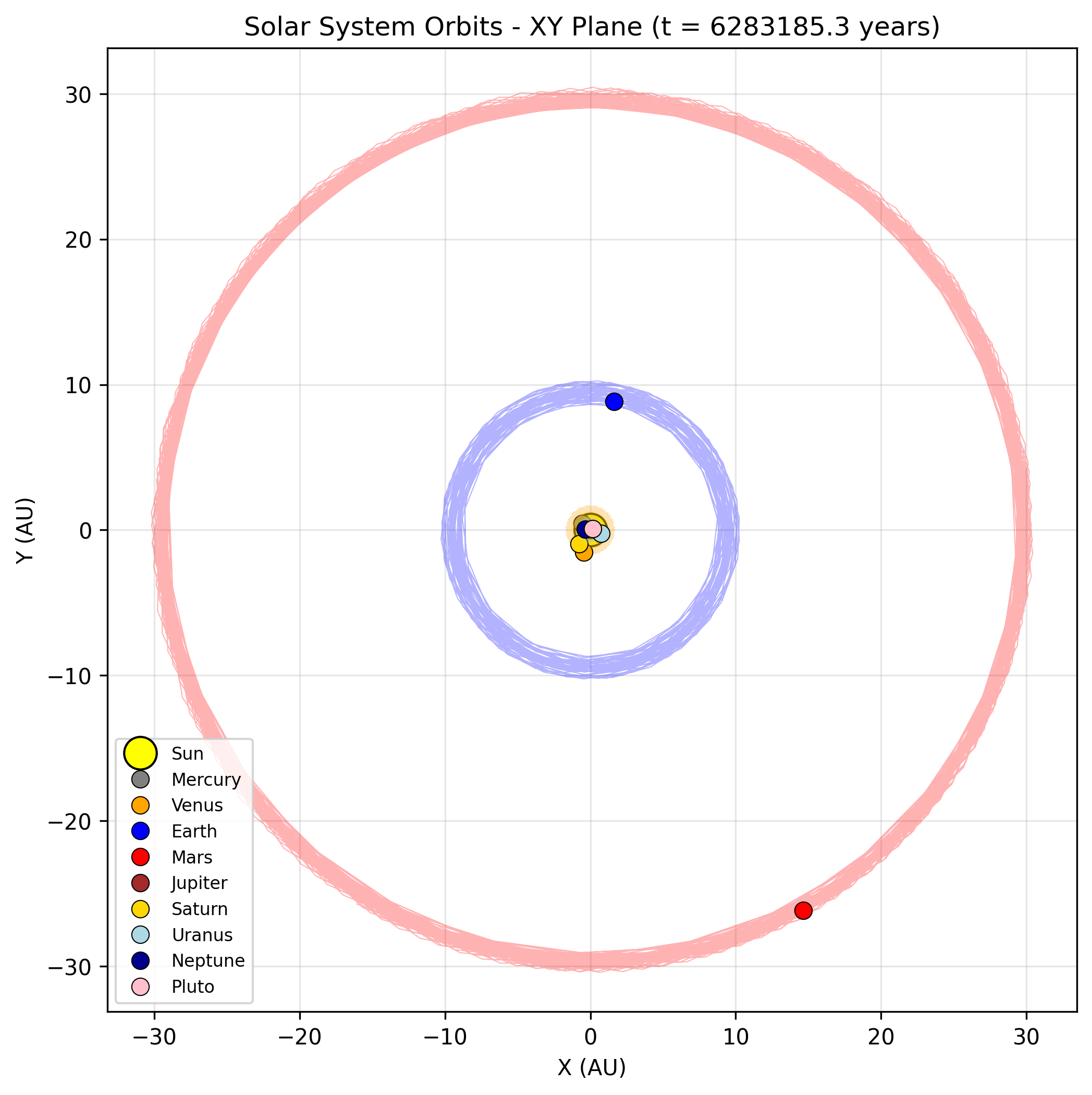
2D Plot
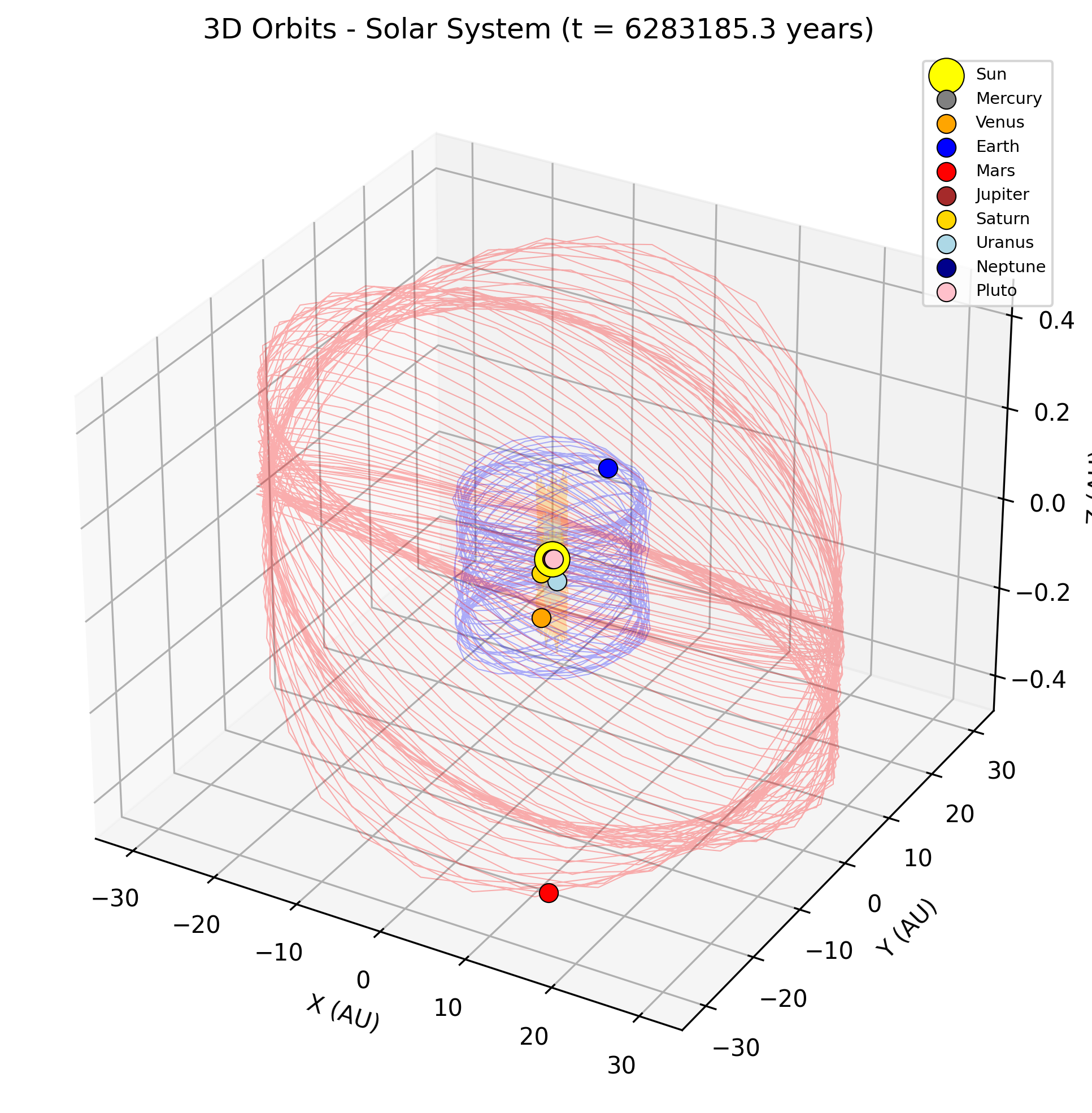
3D Plot
GIF